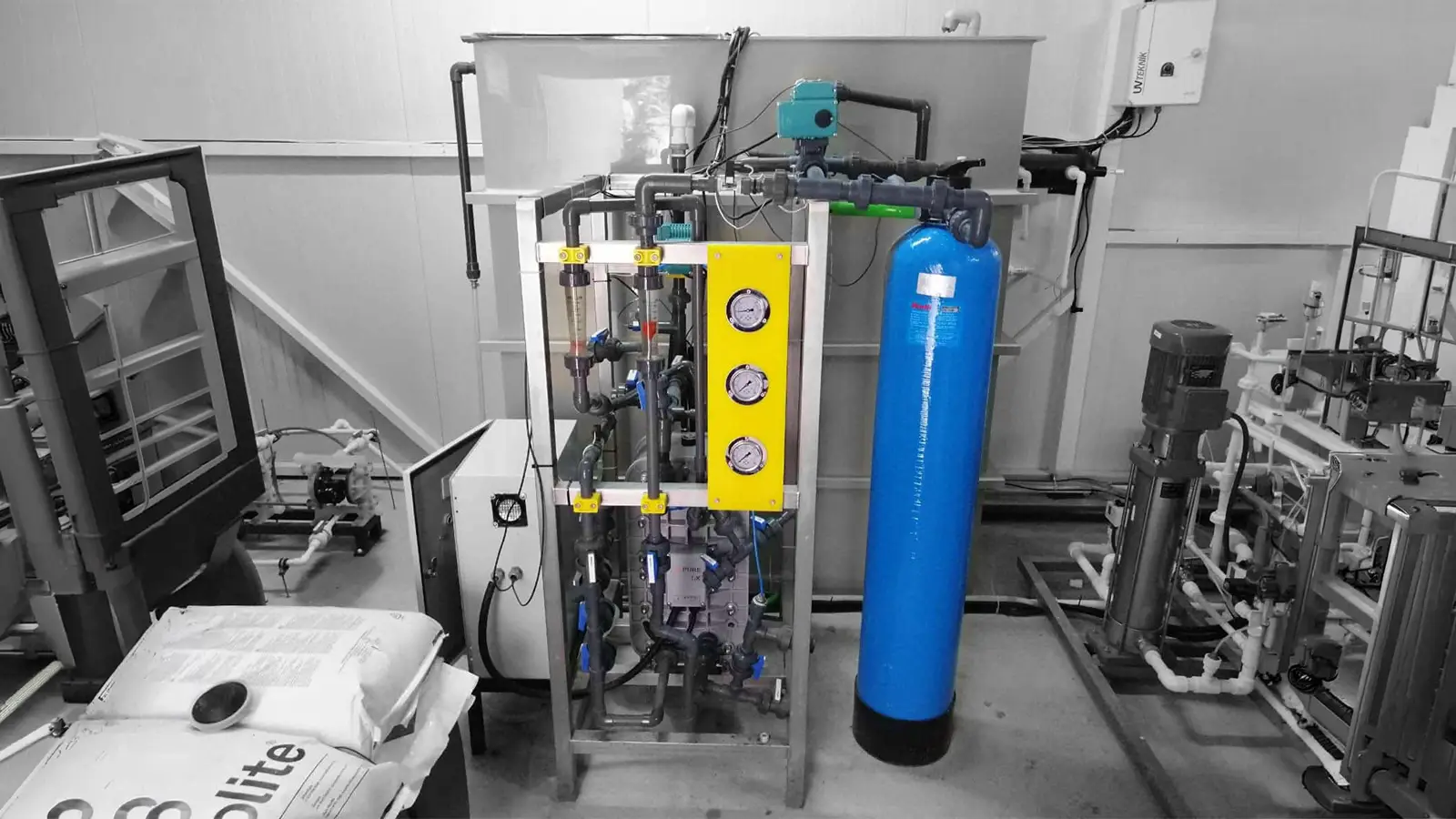
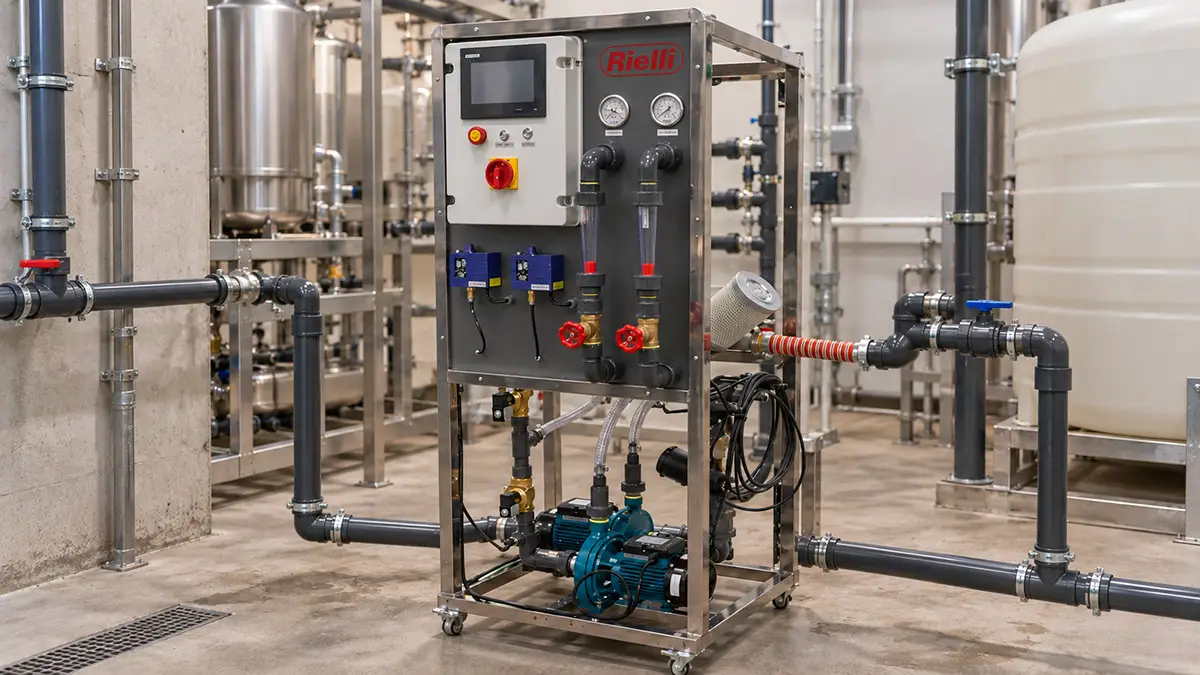
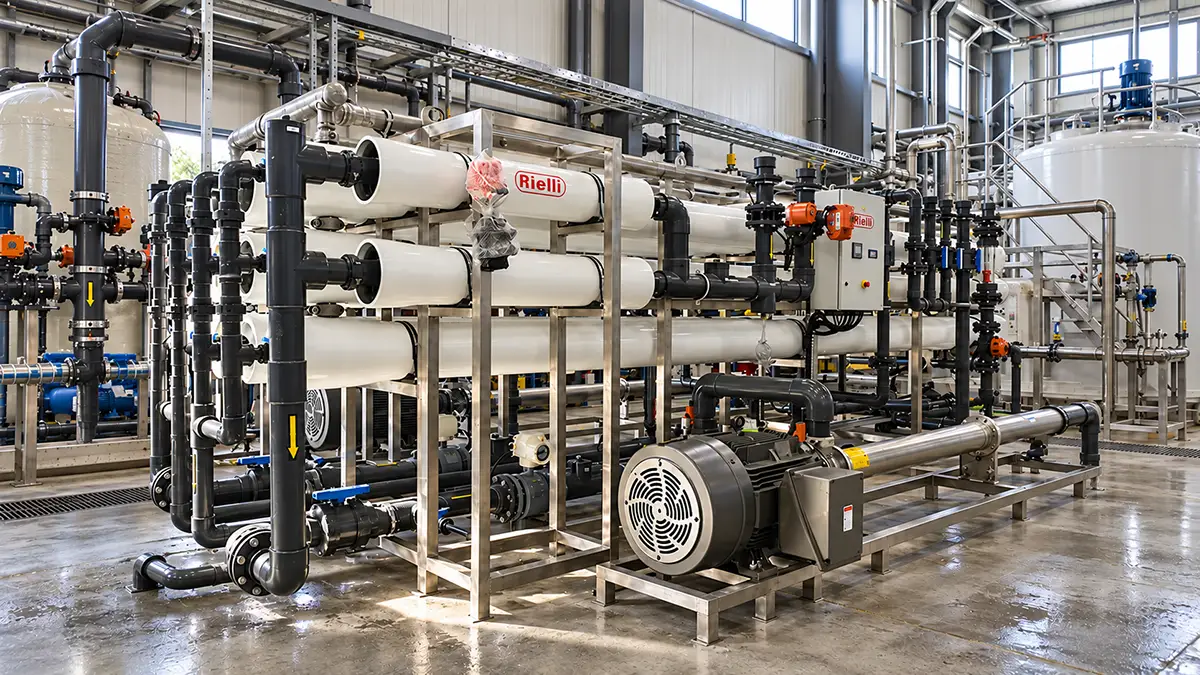
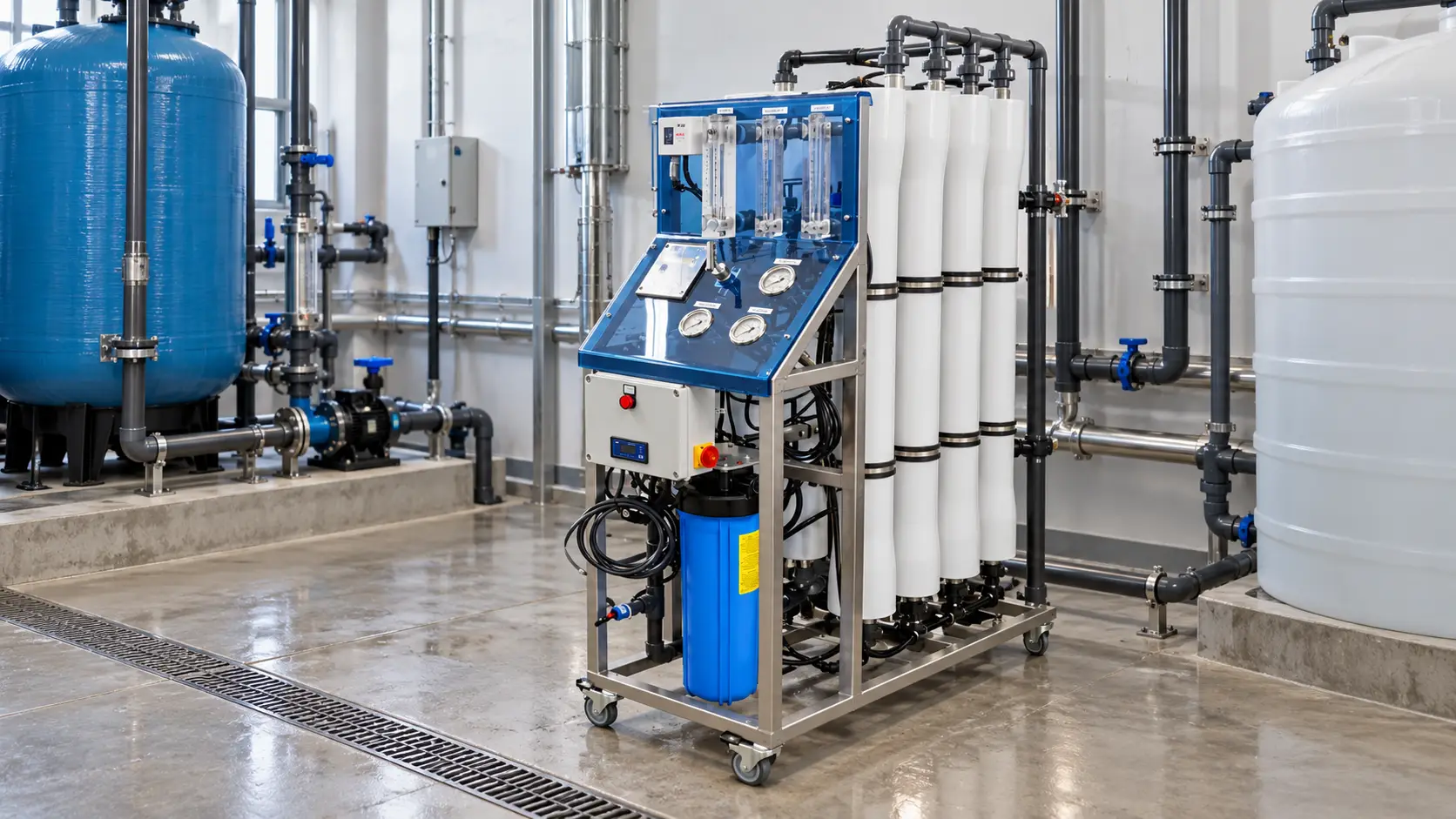
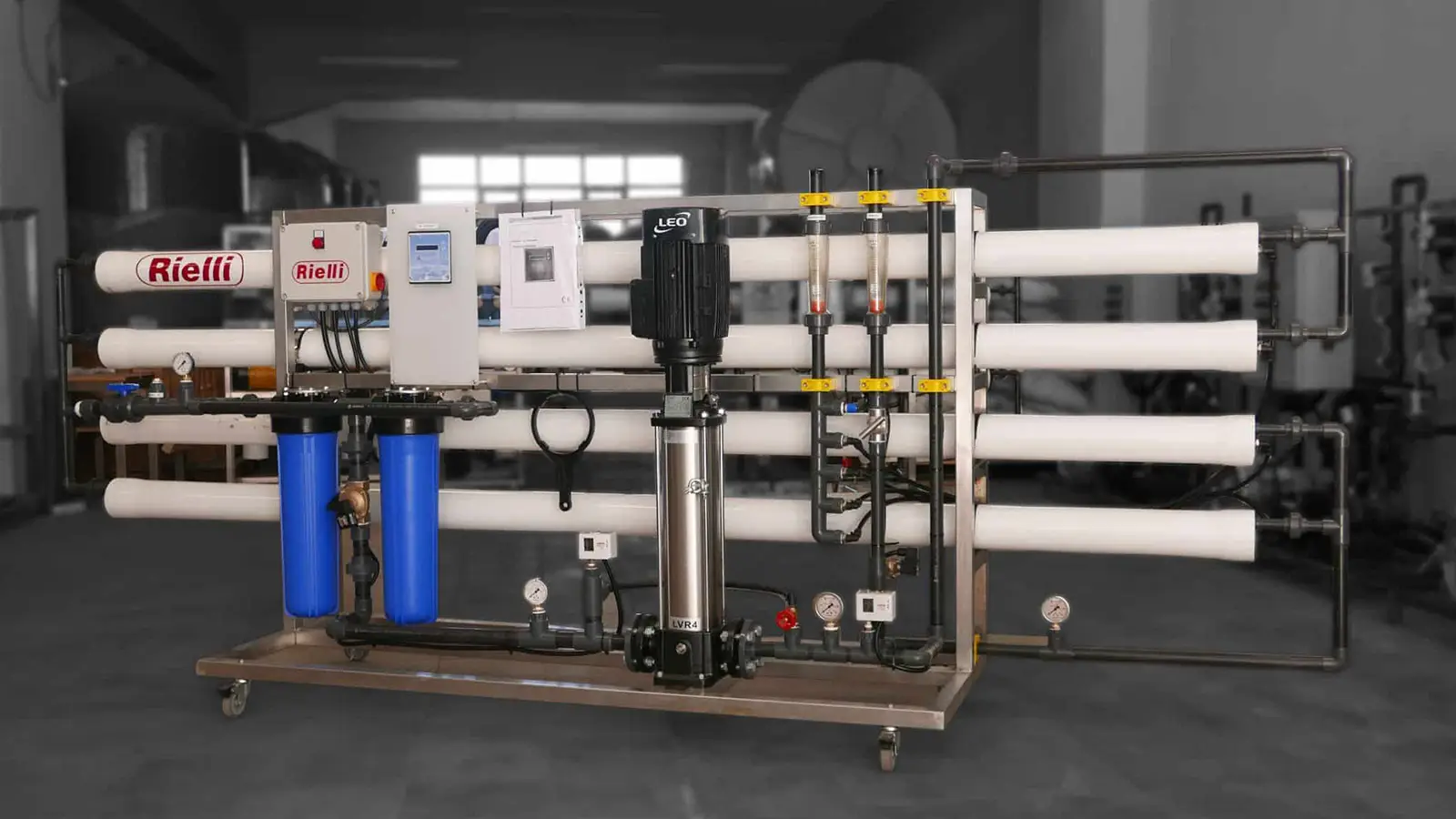
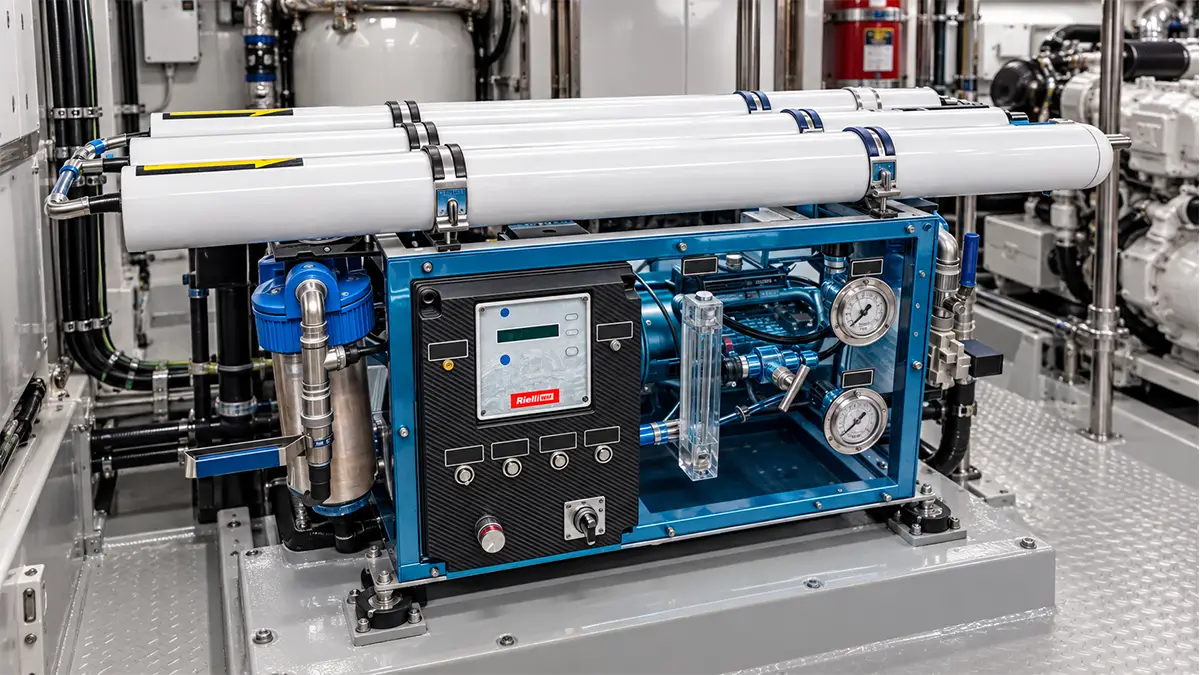
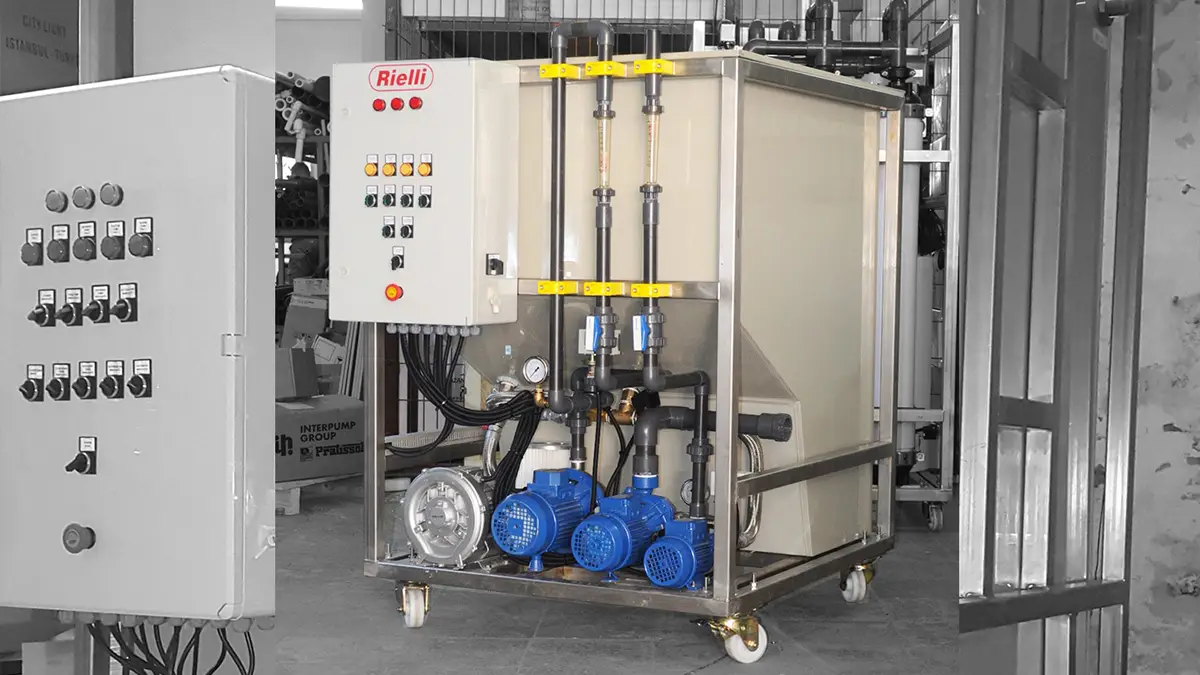
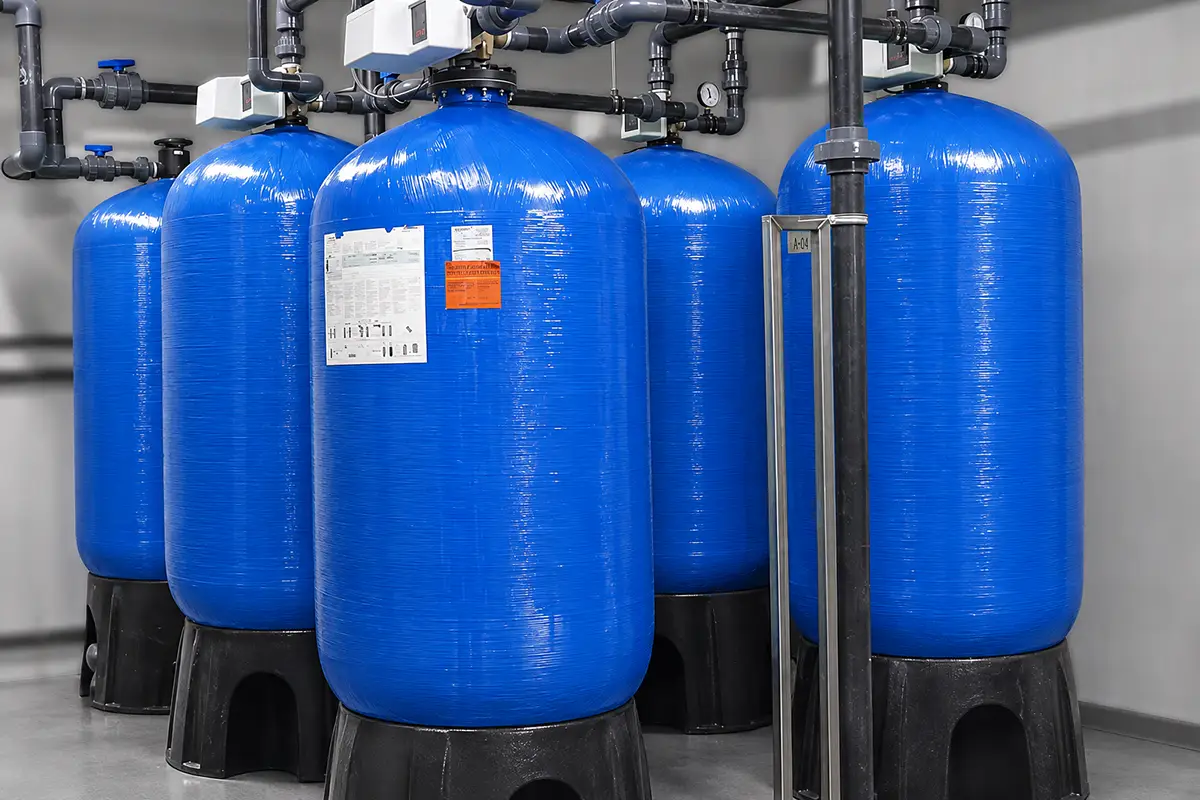
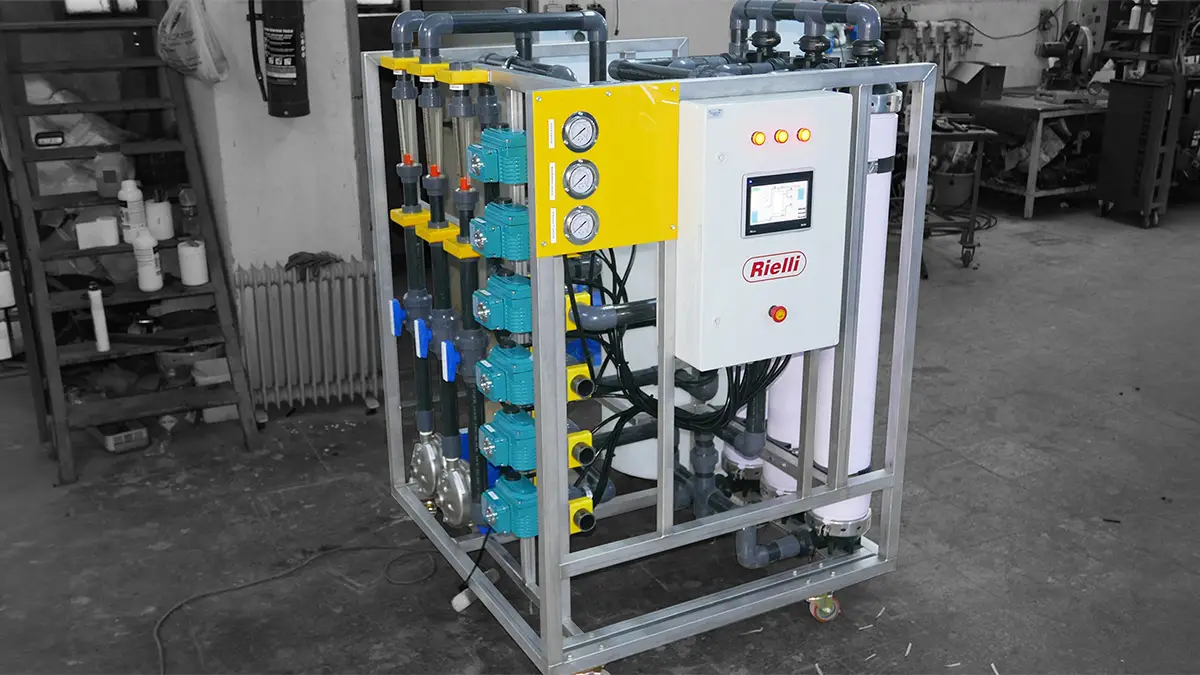
Rielli EDI electrodeionization plants are designed for industrial facilities requiring high-purity deionized water. Typically installed downstream of reverse osmosis (RO) systems, EDI technology removes residual dissolved ions to support the production of low-conductivity process water.
What Is EDI Electrodeionization?
Electrodeionization (EDI) is an advanced water purification technology that combines ion exchange resins, ion-selective membranes, and direct current (DC) electrical power.
An applied electric field drives dissolved ions away from the product water stream and into separate concentrate compartments.
Because the ion exchange resins are continuously regenerated electrically during operation, EDI systems do not require the periodic acid and caustic regeneration processes typically associated with conventional ion exchange demineralization.
This capability supports continuous production of deionized water.
However, chemical requirements for upstream pretreatment and occasional equipment cleaning must still be evaluated as part of the overall treatment system.
For additional information about the role of electrical energy in ion separation technologies, explore the U.S. Department of Energy’s Energy I-Corps Technology Commercialization Resource.
How Do EDI Electrodeionization Systems Work?
Feedwater Preparation Using Reverse Osmosis
EDI systems are generally used for further purification of water that has already undergone reverse osmosis treatment.
Reverse osmosis removes a substantial portion of dissolved salts, while electrodeionization reduces the remaining dissolved ion concentrations.
For this reason, RO and EDI units should be designed as complementary treatment stages.
Learn more about upstream membrane treatment through Rielli’s Industrial Reverse Osmosis (RO) Plants page.
Ion Removal Using an Electric Field
Water flows through an EDI module containing ion exchange resins and ion-selective membranes.
Under the influence of an applied electric field, dissolved ions migrate through the selective membranes into concentrate compartments.
This process reduces the ionic content of the product water and supports the continuous production of deionized water.
Monitoring Product Water Quality
Product water quality is monitored using conductivity or resistivity measurements.
Target water quality values depend on EDI module selection, feedwater quality, flow rate, and operating conditions.
The required performance specifications should be established according to the intended industrial application.
Why Is EDI Feedwater Quality Important?
Stable operation of EDI electrodeionization modules requires feedwater that meets the specifications established by the module manufacturer.
In addition to conductivity, parameters such as hardness, silica, and dissolved carbon dioxide must be evaluated.
Appropriate pretreatment helps reduce the risk of scaling and fouling within the EDI module while maintaining consistent product water quality.
Acceptable feedwater limits vary according to the selected EDI module. Therefore, a single set of feedwater specifications should not be applied to every electrodeionization system.
What Is the Difference Between EDI and Conventional Demineralization?
Both electrodeionization and conventional ion exchange demineralization are technologies used to remove dissolved mineral ions from water.
In conventional resin-based demineralization systems, chemical regeneration is required when the ion exchange resin’s operating capacity becomes depleted.
In EDI systems, electrical regeneration occurs continuously under suitable feedwater and operating conditions.
This approach can reduce the need to store regeneration chemicals and manage waste streams generated by conventional acid and caustic regeneration.
However, the appropriate technology should be selected according to water analysis results, required product water quality, and total operating costs.
For alternative water treatment technologies, explore Rielli’s Water Softening and Demineralization Systems page.
Key Features of Rielli EDI Electrodeionization Plants
Integrated Equipment Compatibility
Rielli EDI plants incorporate Evoqua EDI modules together with supporting treatment and control equipment.
Compatibility between system components is evaluated during the engineering design and equipment integration stages.
Certified Engineering and Production Team
Rielli’s engineers and technicians, certified by Evoqua, participate in the preparation and manufacturing of EDI systems according to project-specific requirements.
Their technical expertise supports appropriate module integration and system configuration.
Quality Control and Functional Testing
Quality inspections and compatibility checks are performed throughout the production process, from equipment acceptance to the completion of the finished system.
The integration of reverse osmosis and electrodeionization units is also evaluated to support coordinated operation.
Operator Training and Technical Support
Rielli provides project-specific operating documentation and post-installation training to help facility personnel manage their EDI systems effectively.
Depending on project requirements, online monitoring and after-sales technical support options may also be available.
Where Are EDI Electrodeionization Systems Used?
EDI systems can be incorporated into high-purity water treatment configurations for applications such as:
- Boiler feedwater preparation in power generation facilities.
- Electronics and microelectronics manufacturing.
- Purified water treatment systems for pharmaceutical production.
- Laboratory water purification applications.
- Industrial processes requiring low dissolved ion concentrations.
Water quality requirements vary between applications.
For sensitive manufacturing processes, organic and microbiological water quality specifications may need to be evaluated alongside ionic purity.
For more information about industrial applications, explore Rielli’s Industrial Process Water Production Solutions page.
Request a Quote for an EDI Electrodeionization Plant
Evaluate suitable EDI electrodeionization systems with Rielli’s engineering team according to your facility’s high-purity water requirements.
To support the initial technical assessment, you can provide:
- Required product water flow rate.
- Target product water conductivity or resistivity.
- Recent RO permeate analysis results.
- Planned daily operating hours.
- Existing water treatment infrastructure.
- Continuous operation and redundancy requirements.
These details help determine suitable EDI module configurations, treatment capacities, and integration requirements for your project.
Request a Quote for an EDI Electrodeionization System →