Marine Watermakers

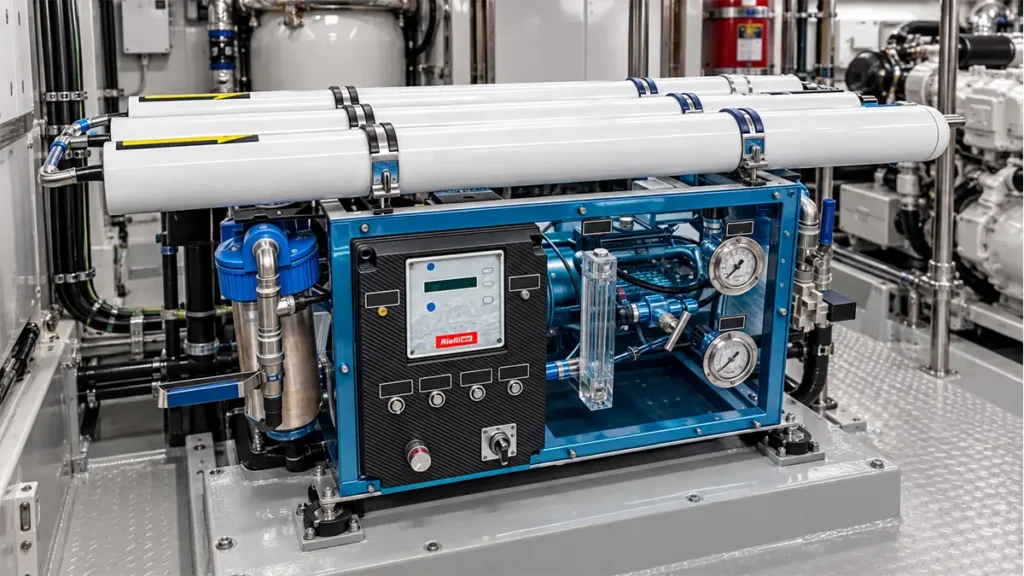
Rielli marine watermakers are reverse osmosis systems designed to produce freshwater from seawater onboard boats and yachts. Featuring modular configurations suitable for marine installations, monitoring instruments, and optional automatic control packages, these systems help meet freshwater requirements during voyages and extended periods at sea.

What Is a Marine Watermaker?

A marine watermaker is a seawater treatment system that uses reverse osmosis membranes to reduce dissolved salt concentrations and produce freshwater.

Commonly referred to as a boat watermaker or yacht watermaker, this equipment allows vessels to produce freshwater directly from seawater, reducing their dependence on shore-based freshwater supplies.

The appropriate production capacity and treatment configuration should be determined according to daily water consumption and the required product water quality.

How Does a Marine Watermaker Work?

Seawater first passes through prefilters to reduce suspended particles before entering the reverse osmosis membranes.

A high-pressure pump then delivers the pretreated seawater to the membranes. A portion of the feedwater passes through the membranes and becomes low-salinity freshwater, while the remaining stream, containing concentrated dissolved salts, is separated as brine or concentrate.

Appropriate pretreatment and operating conditions are essential for maintaining membrane performance.

Freshwater production capacity and product water quality depend on seawater characteristics, membrane specifications, and operating conditions.

Key Features of Rielli Marine Watermakers

Modular Design for Limited Installation Spaces

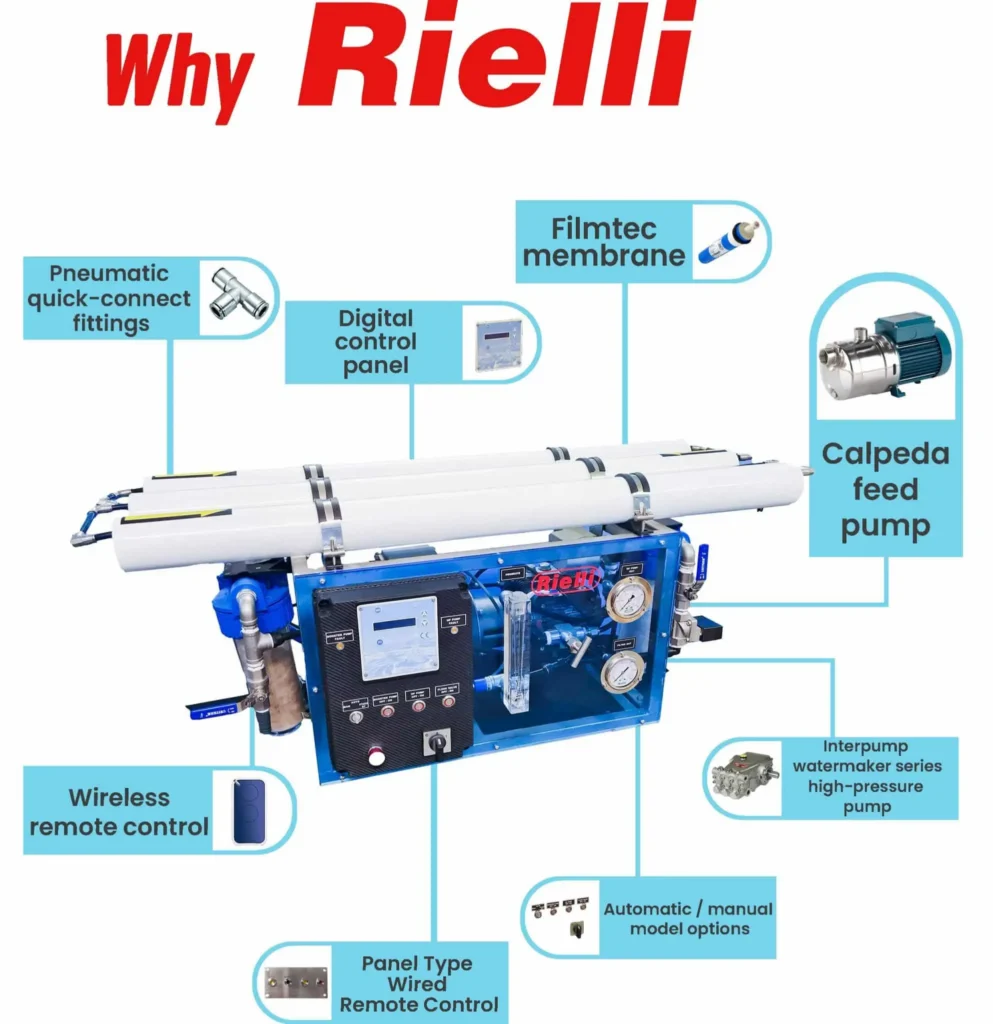
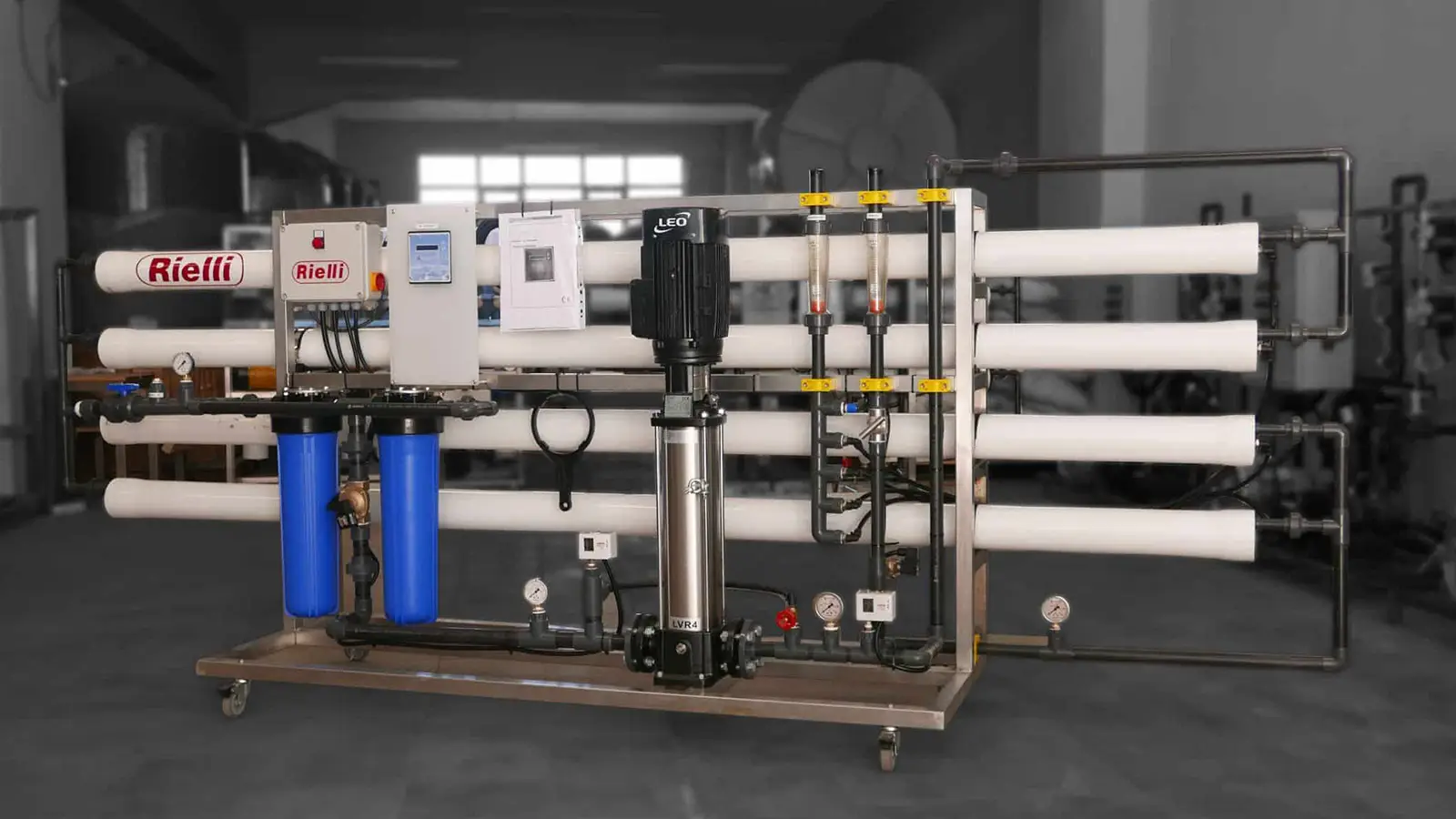
Rielli watermakers feature a modular configuration that allows membrane elements and supporting equipment to be positioned in different locations onboard the vessel.

This flexibility helps accommodate installation requirements in compact engine rooms and other technical spaces.

The stainless steel frame, flexible high-pressure hoses, and anti-vibration mounts support practical installation and operation in marine environments.

Freshwater Production Monitoring

Product water flow rate and conductivity can be monitored directly through the system’s instruments.

SS316 stainless steel flow meters and pressure gauges help operators monitor operating conditions and evaluate system performance.

Dual-Stage Prefiltration

A two-stage prefiltration arrangement using 25-micron and 5-micron filters helps reduce the particle load reaching the reverse osmosis membranes.

High-strength fiberglass-reinforced plastic (FRP) membrane pressure vessels and SS316 stainless steel high-pressure connections complete the system’s technical configuration.

Optional Automatic Control Packages

Rielli marine watermakers are available with automatic control package options designed to simplify operation and system monitoring.

Depending on the selected model and equipment package, available features include:

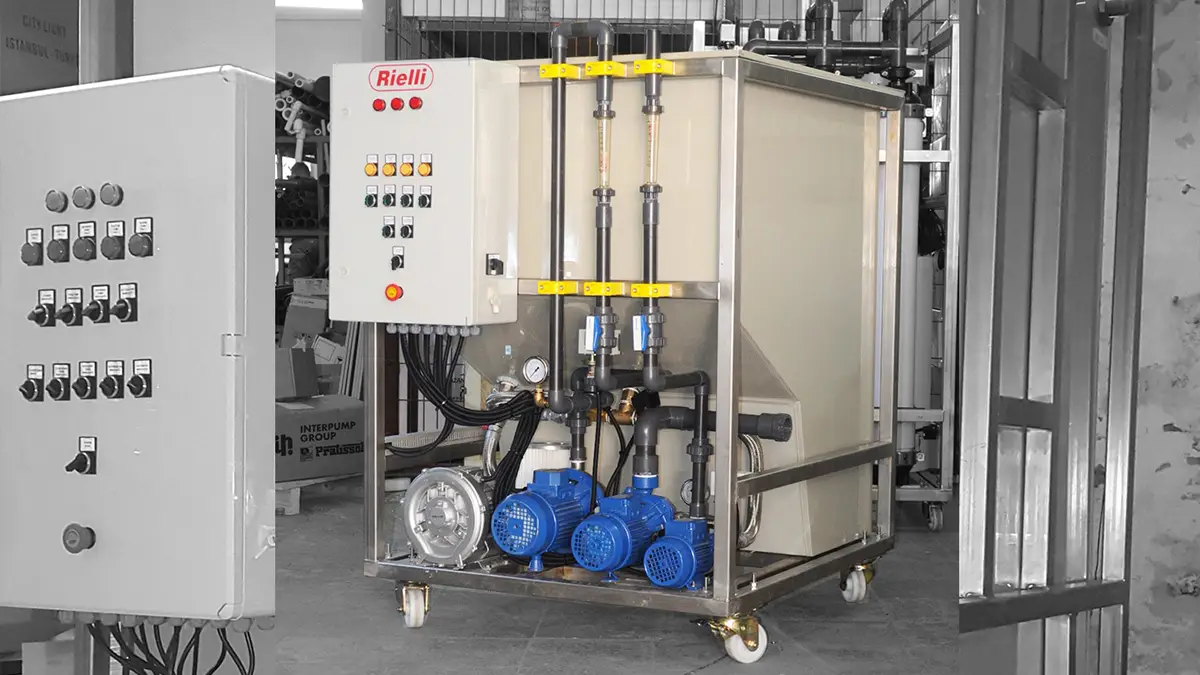
  • Digital control panel for system operation and monitoring.
  • Wireless RF remote control for convenient operation.
  • Wired remote control with feedback signals.
  • Automatic freshwater flushing system to support membrane maintenance.

The availability and specifications of these features should be confirmed according to the selected model and automatic control package.

Local Manufacturing and Technical Support

Rielli marine watermakers undergo quality and compatibility checks during production.

Operating documentation, post-installation training, and technical service support help operators manage their equipment and maintain reliable operation.

Can Water Produced by a Marine Watermaker Be Used for Drinking?

Producing drinking water from seawater is technically possible. However, reducing seawater salinity through reverse osmosis alone does not automatically guarantee drinking water safety.

The quality of the source water, treatment processes, and chemical and microbiological characteristics of the produced water must all be evaluated.

Depending on the intended application, additional treatment processes may be required. Water storage, tank hygiene, and onboard distribution conditions are also important factors in maintaining drinking water quality.

For further technical information, explore the World Health Organization’s Guidance on Safe Drinking-Water Production through Desalination.

You can also learn more about Rielli’s related engineering approach through our Drinking Water Production from Seawater Solutions page.

What Should You Consider When Choosing a Watermaker for Your Boat?

Selecting the right marine reverse osmosis watermaker requires an assessment of your vessel’s actual freshwater consumption, available installation space, and operating conditions.

To support the selection process, you can provide the following information:

  • Number of people onboard and estimated daily freshwater consumption.
  • Planned daily operating hours of the watermaker.
  • Freshwater storage tank capacity.
  • Available installation space and maintenance accessibility.
  • Electrical power supply and existing onboard energy infrastructure.
  • Navigation area and expected seawater conditions.
  • Preference for manual or automatic operation.

When determining the required capacity, hourly freshwater production and total daily water demand should be evaluated together.

It is also important to confirm the seawater temperature and salinity conditions under which the manufacturer’s stated production capacity is specified.

These factors help determine whether the selected watermaker can meet the vessel’s freshwater requirements under actual operating conditions.

Request a Quote for a Marine Watermaker

Find a Rielli marine watermaker that meets your boat’s or yacht’s freshwater production requirements.

Share your daily freshwater demand, available installation space, electrical power supply, and operating preferences with Rielli’s engineering team to evaluate suitable watermaker models, production capacities, and control options.

For larger-scale seawater treatment applications, you can also explore our Seawater Desalination Plants page.

Request a Quote for a Marine Watermaker →
Marine Watermaker Models

On smaller screens, scroll horizontally to view all specifications.

Comparison of Rielli marine watermaker models, including production capacity, membrane configuration, and power requirements.
Model Capacity (L/h) Membrane Type Rated Power (kW) Feed Pump Power (kW)
012540H 100 1 × 2540 1.7 0.55
022540H 150 2 × 2540 2.2 0.55
022540H/M 150 2 × 2540 2.2 0.55
032540H 190 3 × 2540 2.2 0.55
042540H 240 4 × 2540 2.2 0.55
024040H 350 2 × 4040 3 0.55
024040H/M 350 2 × 4040 3 0.55
034040H 450 3 × 4040 3 0.55

Marine Watermaker Dimensions

Columns A–H correspond to the dimension reference points shown in the technical drawing. All dimensions are expressed in millimeters (mm).

On smaller screens, scroll horizontally to view all dimensions.

Dimensions A–H of Rielli marine watermaker models, expressed in millimeters.
Model A B C D E F G H
012540H 650 1145 475 515 315 100 270 80
022540H 650 1145 475 515 315 100 270 80
022540H/M 650 1145 475 515 315 100 270 80
032540H 650 1200 475 550 315 100 270 130
042540H 650 1145 475 515 315 100 270 80
024040H 650 1145 525 515 315 100 270 80
024040H/M 650 1200 475 550 315 100 270 130
034040H 650 1200 580 550 315 100 270 130

FAQ

A marine watermaker is a reverse osmosis system designed to produce freshwater from seawater.

Commonly used on boats and yachts, watermakers help meet onboard freshwater requirements while reducing dependence on shore-based water supplies.

Seawater first passes through prefilters before being delivered to the reverse osmosis membranes under high pressure.

A portion of the water passes through the membranes to produce low-salinity freshwater, while the remaining portion is discharged as a concentrate or brine stream.

For more information about seawater reverse osmosis technology, explore our Seawater Desalination Plants page.

Reducing seawater salinity alone is not sufficient to guarantee drinking water safety.

The chemical and microbiological quality of the produced water, necessary post-treatment processes, and onboard storage conditions must all be evaluated.

Conductivity measurements alone cannot confirm whether the produced water is safe for drinking.

For further information, explore Rielli's Drinking Water Production from Seawater Solutions and the World Health Organization's guidance on desalination and drinking water safety.

Selecting the appropriate marine watermaker capacity requires evaluating daily freshwater consumption and the planned operating hours of the equipment.

The number of people onboard, shower and kitchen usage, freshwater storage tank capacity, and available electrical power are also important factors.

For example, meeting a daily freshwater demand of 600 liters with four hours of operation would theoretically require a production capacity of 150 L/h.

However, actual system selection must also consider operating conditions and an appropriate capacity margin.

According to Rielli's model specifications, available nominal freshwater production capacities include 100, 150, 190, 240, 350, and 450 liters per hour (L/h).

These values represent hourly production capacities rather than daily freshwater output.

Actual daily production depends on equipment operating hours and real operating conditions.

Yes. The modular design of Rielli marine watermakers allows membranes and supporting equipment to be installed in different locations onboard the vessel.

This flexibility can help accommodate installations in compact technical spaces.

However, installation planning must consider not only equipment dimensions but also sufficient space for filter replacement, maintenance access, and system connections.

The Rielli automatic watermaker package includes features such as:

  • Digital control panel.
  • Wireless RF remote control.
  • Wired remote control with feedback signals.
  • Automatic freshwater flushing system.

The exact equipment configuration and included functions should be confirmed for the selected model during the quotation process.

Yes. Rielli marine watermakers allow operators to monitor the instantaneous product water flow rate and conductivity directly through the system's instruments.

Pressure gauges also support the monitoring of operating conditions.

These measurements help operators identify potential changes in system performance.

Rielli marine watermakers feature a dual-stage prefiltration system with 25-micron and 5-micron filters.

These filters help reduce the amount of suspended particles reaching the reverse osmosis membranes.

Filter inspections and replacement intervals should be determined according to operating conditions and manufacturer recommendations.

Rielli's watermaker model specifications list rated power and feed pump power separately.

When evaluating a vessel's electrical infrastructure, total power requirements, pump starting conditions, and planned daily operating hours should all be considered.

It is important to distinguish between kilowatts (kW), which measure power, and kilowatt-hours (kWh), which measure energy consumption.

The technical specifications of the selected watermaker model should be used to estimate actual energy consumption.

To request a quotation, you can provide information about your vessel type, daily freshwater requirements, planned operating hours, electrical power supply, and available installation space.

Specifying whether you prefer manual or automatic operation will also help determine the most suitable model and equipment configuration.

You can contact Rielli to request a customized marine watermaker proposal and discuss suitable production capacities and control options for your vessel.

Didn’t Find the Answer You Were Looking For?

For more information about water treatment systems, technologies, and applications, visit our Frequently Asked Questions (FAQ) page. Find answers to common questions about reverse osmosis, seawater desalination, grey water recycling, wastewater reuse, membrane filtration systems, and industrial process water treatment.

→ Explore Our Frequently Asked Questions

Reliable Solutions for Sustainable Water Management

At Rielli, we develop high-efficiency water treatment and recovery systems tailored to a wide range of needs—from industrial facilities and tourism infrastructure to the maritime sector and municipal applications. We provide customized solutions at every stage, from project design and commissioning to technical support and after-sales services.