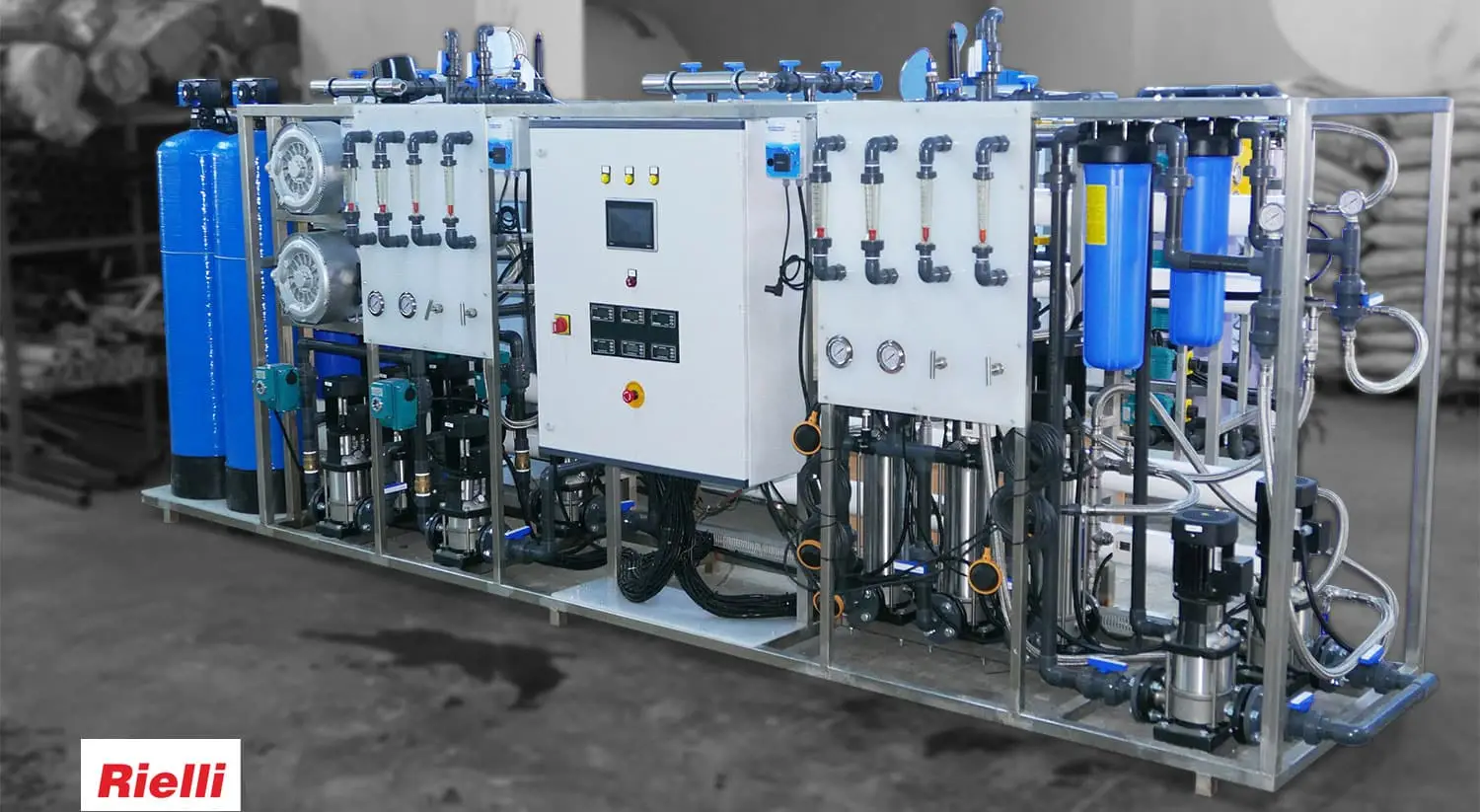
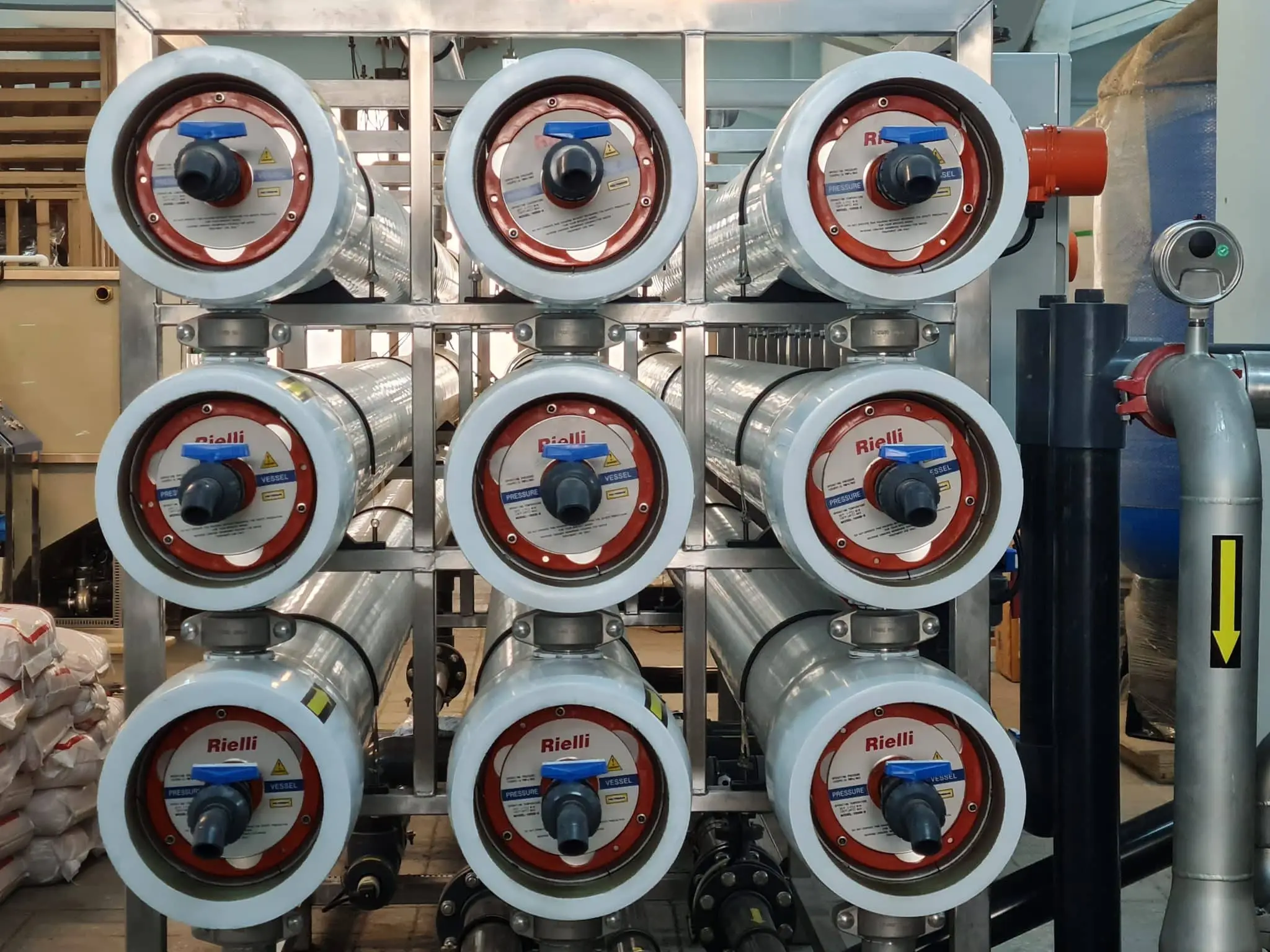
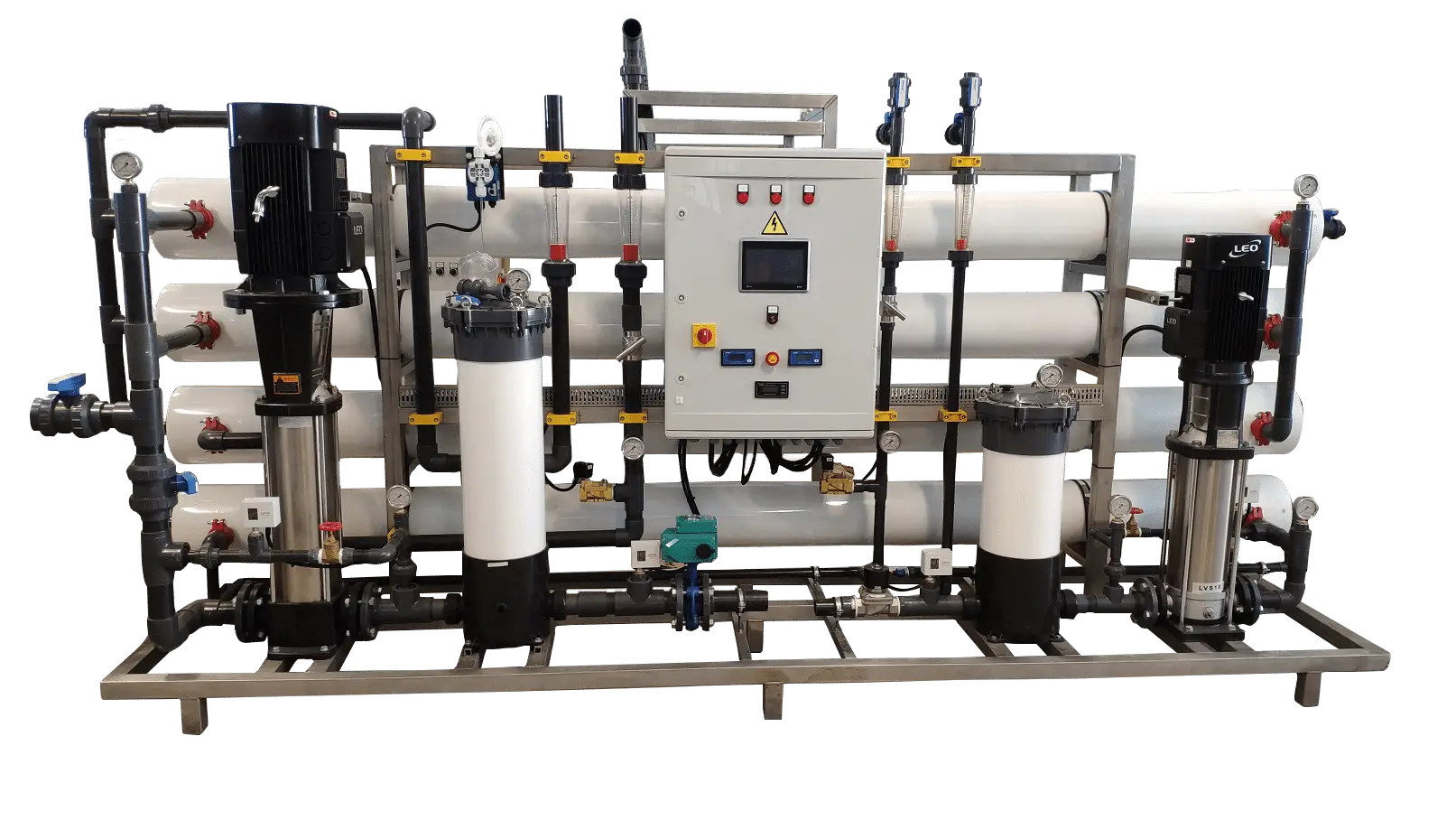
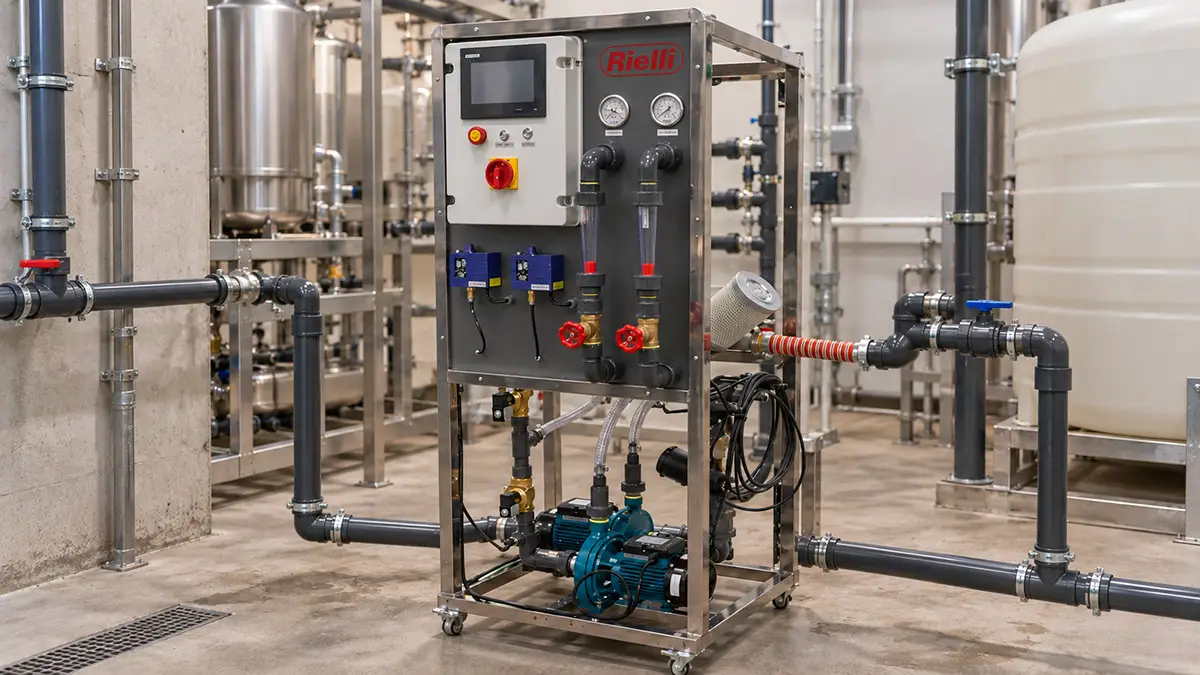
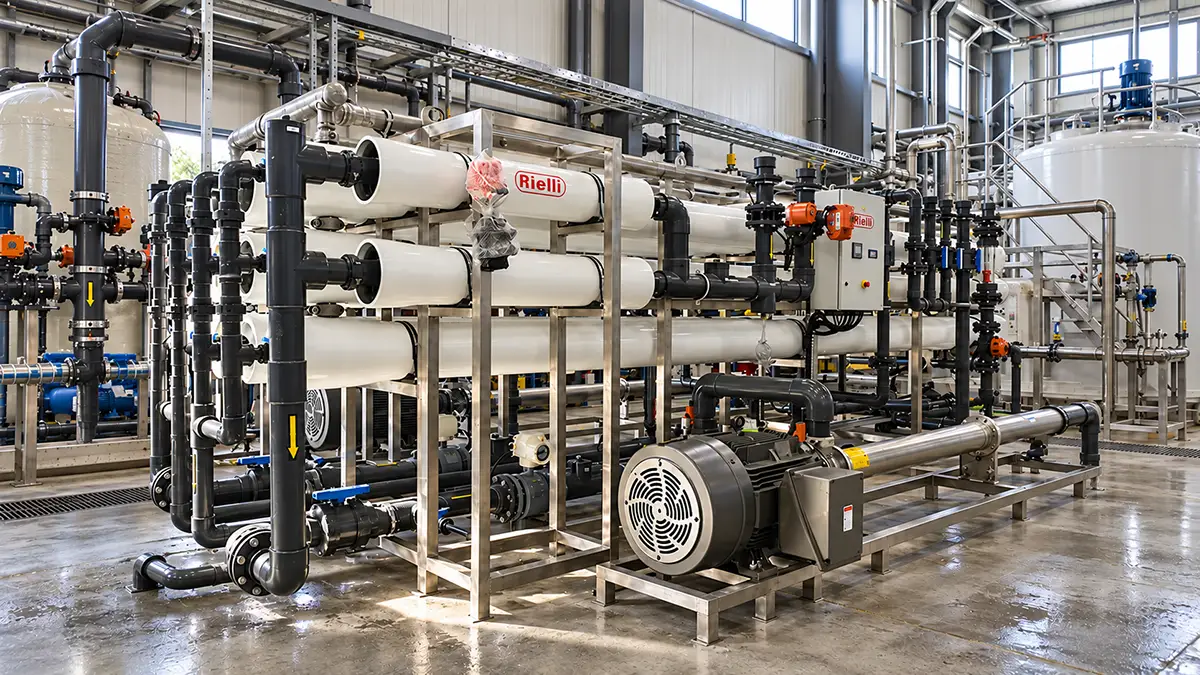
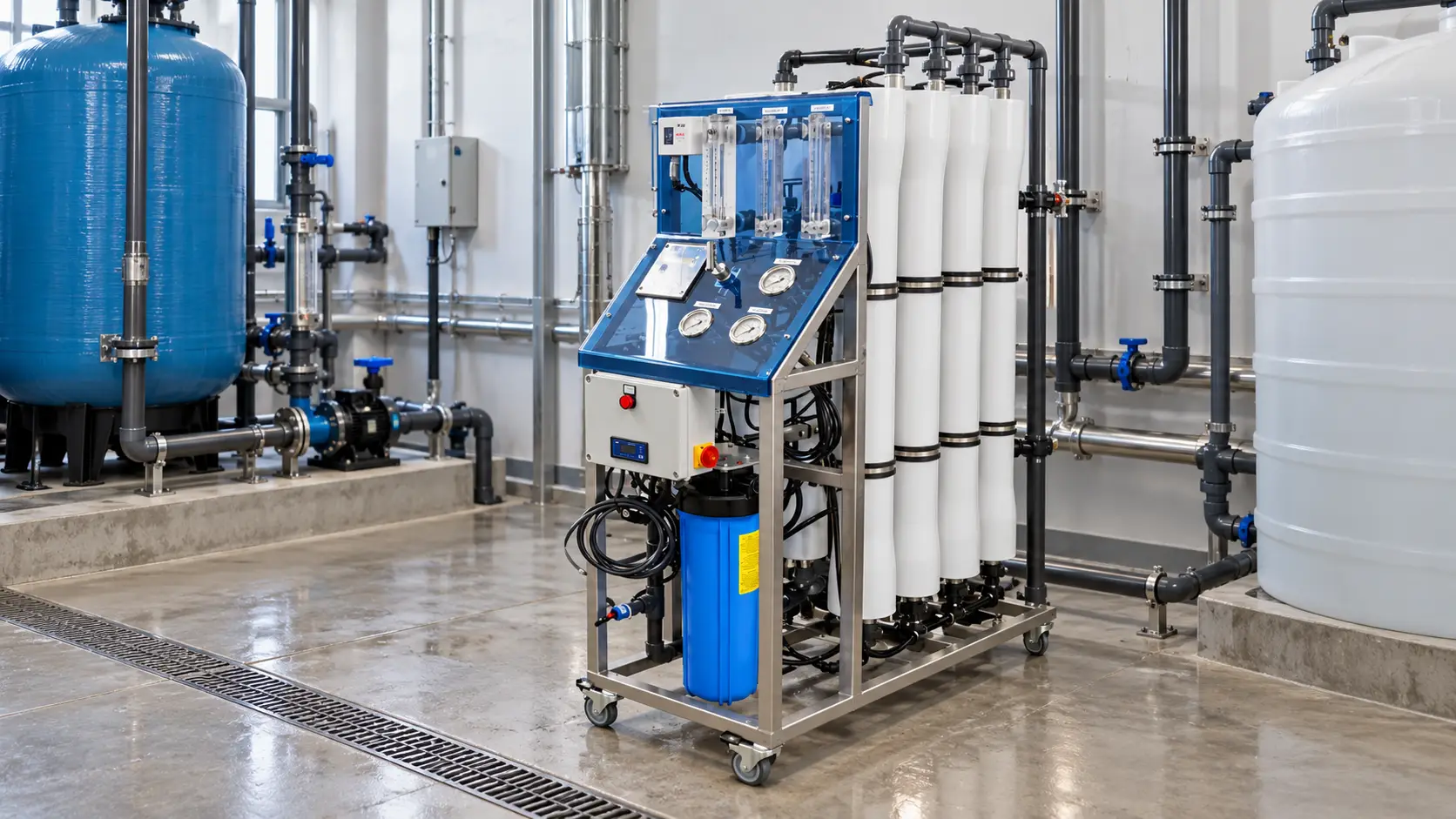
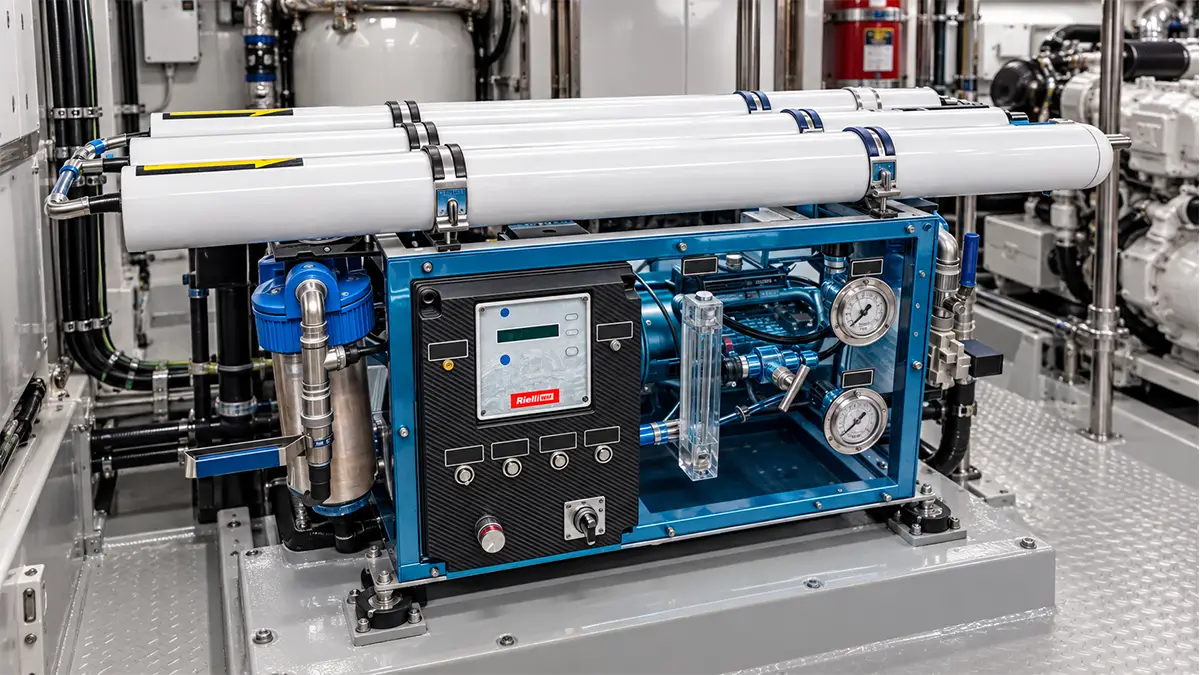
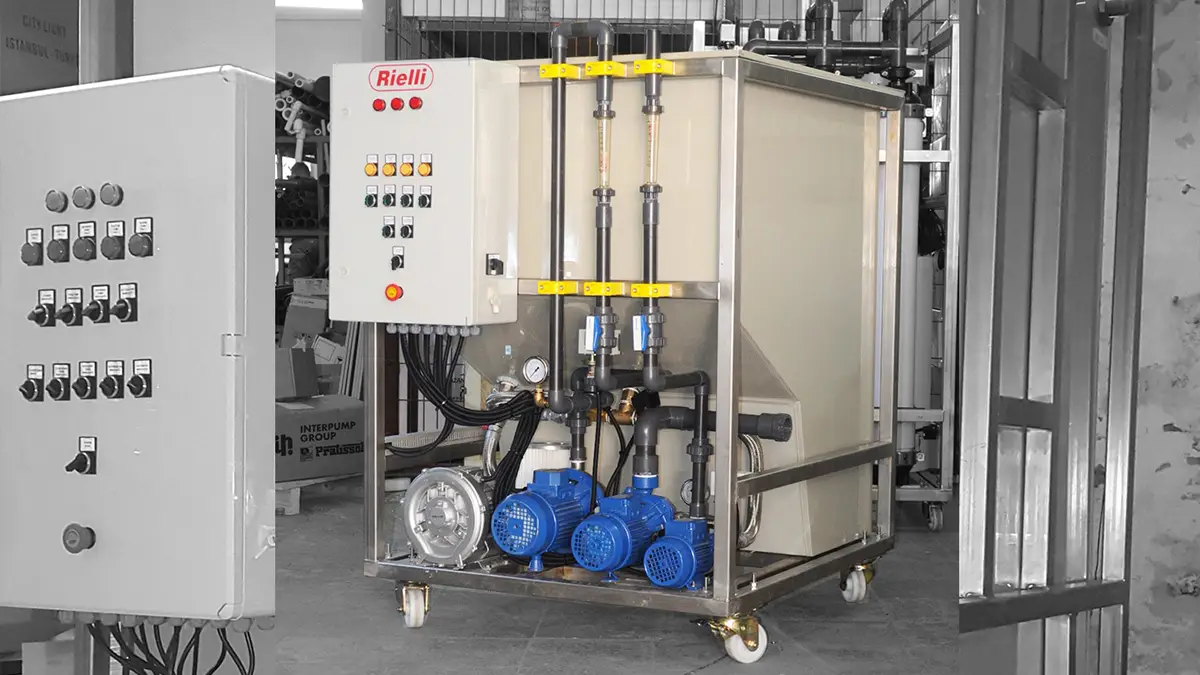
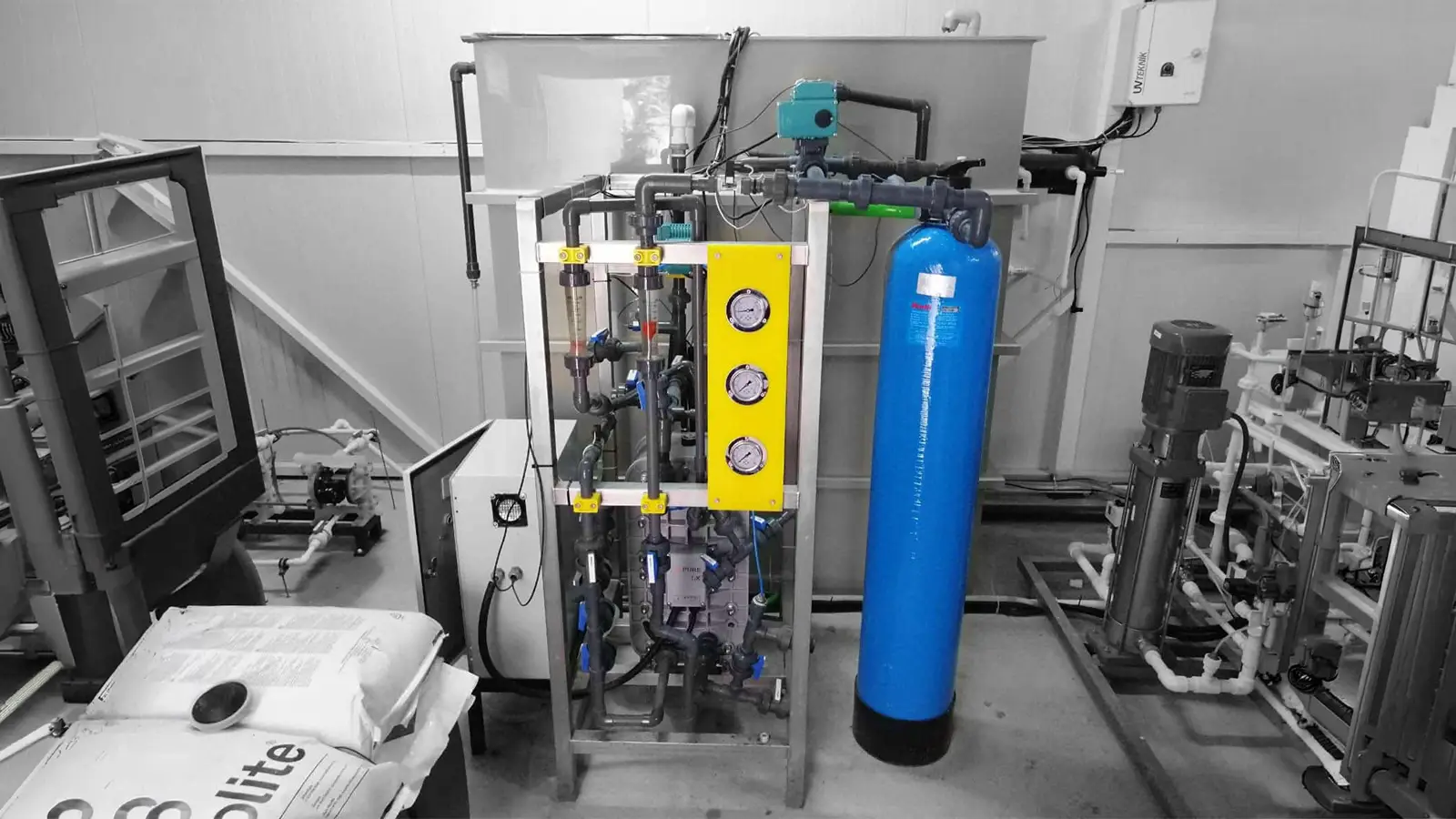
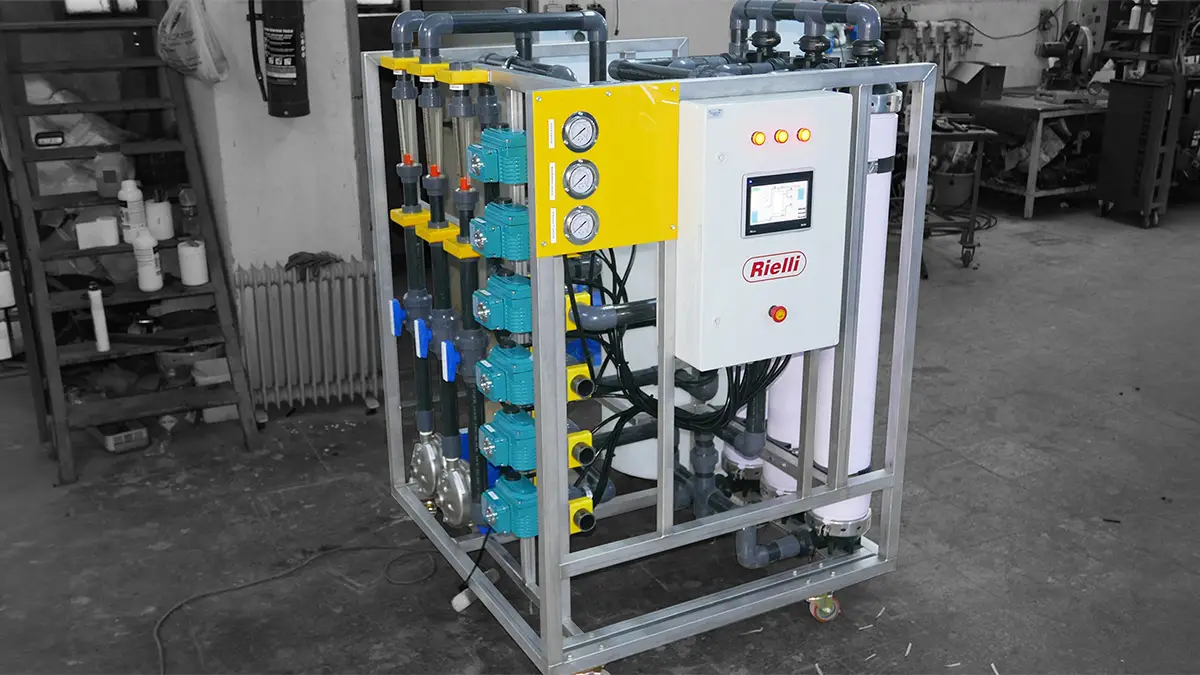
Rielli industrial reverse osmosis plants are engineered according to the water quality and production capacity requirements of each facility. Using membrane technology to reduce dissolved salts and other contaminants, these systems prepare water from suitable sources for industrial process applications.
Each industrial RO system is designed by evaluating initial investment costs, long-term operating expenses, and site-specific operating conditions together. This approach supports the selection of water treatment equipment that meets both technical and economic requirements.
What Is an Industrial Reverse Osmosis Plant?
An industrial reverse osmosis (RO) plant is a water treatment system that uses pressure to force water through semipermeable membranes, reducing dissolved salts and various other contaminants.
During the treatment process, feedwater is separated into two streams: treated product water, also known as permeate, and a concentrate stream containing higher concentrations of rejected substances.
Reverse osmosis is not simply a filtration process for removing suspended particles. It is a membrane separation technology used when the reduction of dissolved substances is required.
The quality of the treated water depends on feedwater characteristics, membrane selection, and operating conditions.
How Do Industrial Reverse Osmosis Plants Work?
Pretreatment to Protect RO Membranes
Feedwater is evaluated for substances that may cause membrane fouling, scaling, or performance deterioration.
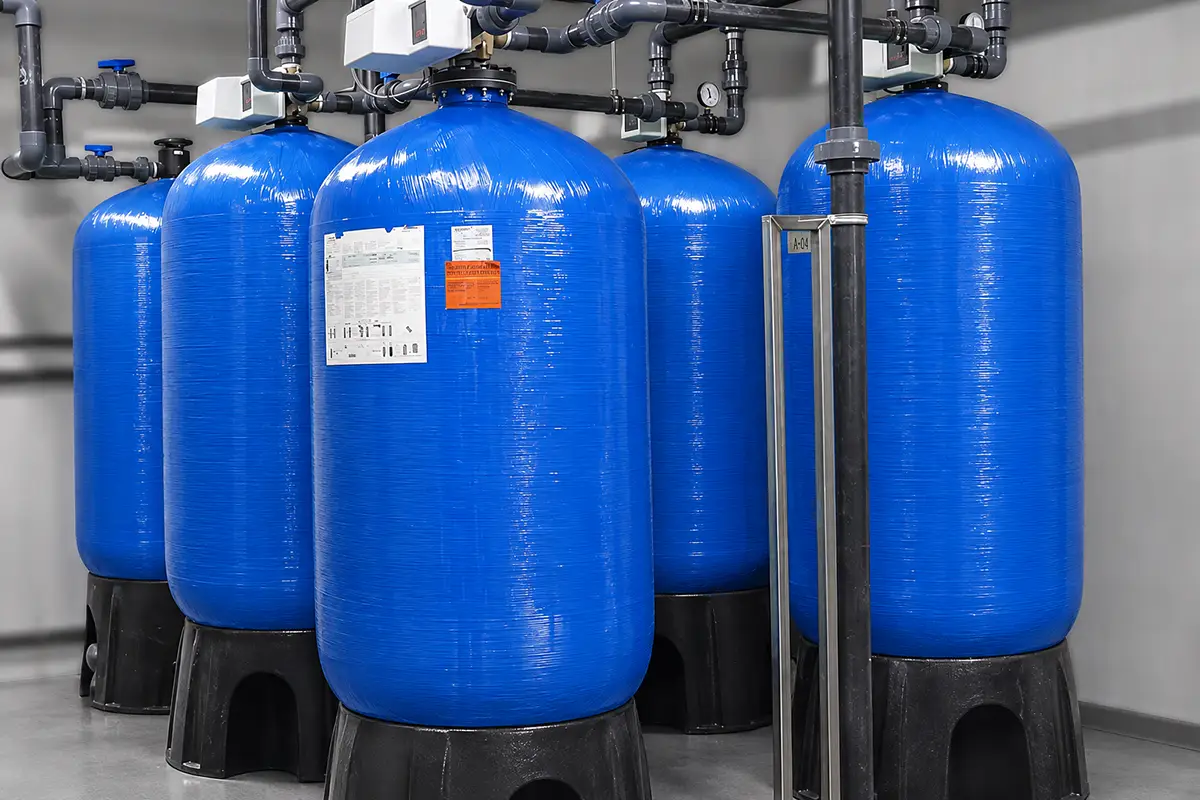
Depending on water analysis results, pretreatment may include filtration, water softening, or appropriate chemical conditioning.
Proper pretreatment helps protect reverse osmosis membranes and maintain stable operating performance.
Membrane Filtration Under Pressure
Following pretreatment, water is delivered to the reverse osmosis membranes using a high-pressure pumping system.
A portion of the feedwater passes through the membranes to produce treated product water, while the remaining portion is separated as concentrate.
Therefore, industrial RO system design must consider not only the required product water capacity but also the management of the concentrate stream.
Post-Treatment According to Water Quality Requirements
Depending on the intended application, RO permeate may require additional treatment or conditioning, such as pH adjustment or further purification.
For more information about reverse osmosis and related treatment processes, explore the U.S. Environmental Protection Agency’s Overview of Drinking Water Treatment Technologies.
Where Are Industrial Reverse Osmosis Plants Used?
Water quality requirements vary across industrial sectors, including textile manufacturing, chemical production, paper manufacturing, paint production, and other industrial processes.
Industrial reverse osmosis systems can be integrated into process water treatment configurations designed to meet these specific requirements.
For applications requiring higher water purity, reverse osmosis may be combined with additional treatment technologies.
Learn more about industry-specific applications through Rielli’s Industrial Process Water Production Solutions page.
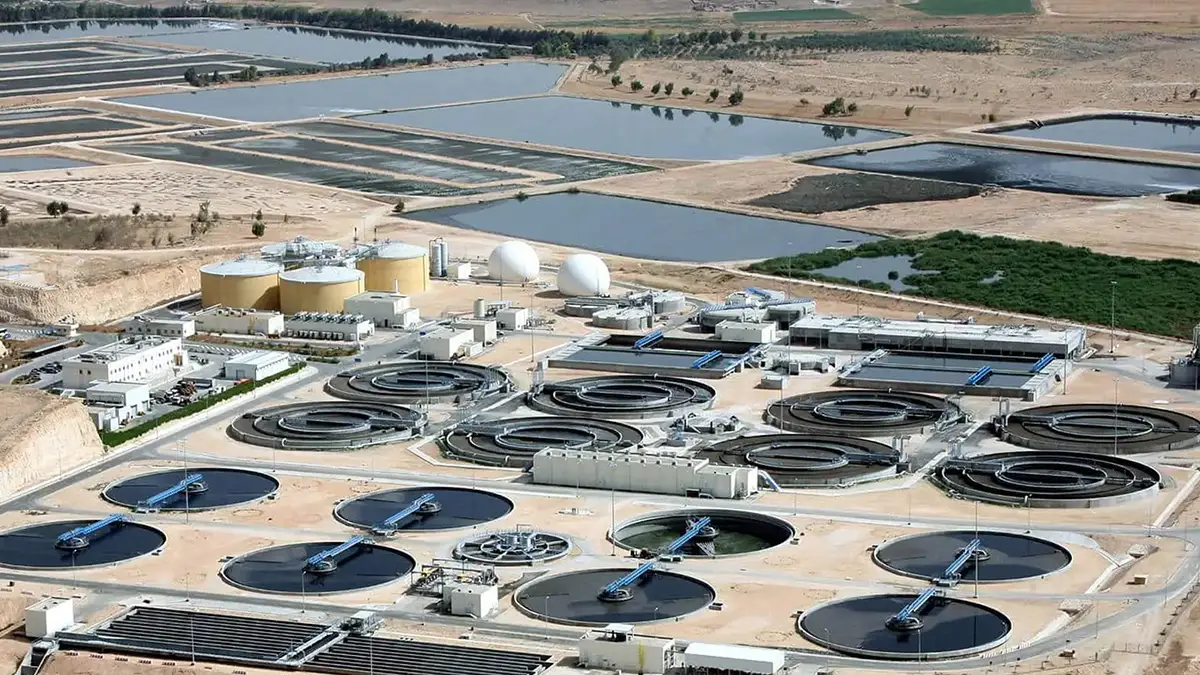
Reverse osmosis can also be used for recycling appropriately treated wastewater.
In these applications, feedwater quality and pretreatment performance are particularly important for maintaining membrane operation and achieving the required product water specifications.
For more information, explore our Wastewater Recycling and Process Water Production Solutions.
Advantages of Rielli Industrial Reverse Osmosis Plants
Project-Specific Engineering
Rielli engineers use membrane manufacturers’ projection software to develop reverse osmosis system designs according to project-specific requirements.
Equipment selection is evaluated alongside technical specifications, operating conditions, and economic considerations.
Direct Procurement and Quality Control
Direct procurement from equipment manufacturers and consolidated purchasing practices support effective cost management.
Equipment inspections and compatibility tests are performed during production and system integration to verify the operation of selected components.
Production and Delivery Planning
Maintaining selected equipment ready for production and working directly with manufacturers helps support procurement and delivery planning.
Actual delivery times are determined according to project scope, equipment availability, and technical requirements.
Operator Training and After-Sales Support
Project-specific operating documentation and post-installation training help facility personnel manage their industrial reverse osmosis systems effectively.
Depending on project requirements, online monitoring and technical service support may also be provided.
Evaluation of Investment and Operating Costs
Project proposals consider initial investment, operating expenses, and estimated investment payback periods.
Depending on project feasibility and commercial conditions, alternatives such as equipment purchase, leasing, or purchasing treated water may also be discussed.
Request a Quote for an Industrial Reverse Osmosis Plant
To evaluate the most suitable industrial reverse osmosis system for your facility, you can provide Rielli with the following information:
- Water source and recent water analysis results.
- Required hourly or daily product water capacity.
- Target water quality and intended application.
- Daily operating hours.
- Existing pretreatment and water storage infrastructure.
- Available installation space and automation requirements.
Let’s evaluate your technical specifications and operating costs together to identify an appropriate water treatment solution for your facility.
Request a Quote for an Industrial Reverse Osmosis Plant →